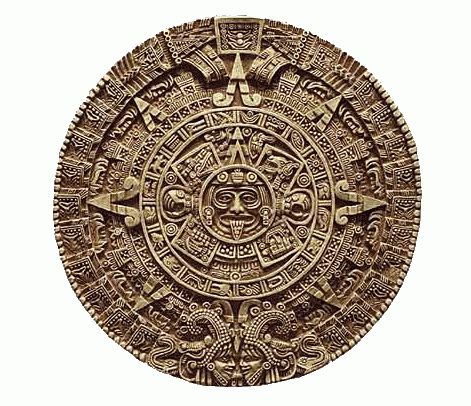
When we talk about the Mayan Calendar, it is better to talk about a calendaric system where you have several different techniques to date a day.
Mayans did not have a single calendar to use, but they characterized the date based on different kinds of calendars that they designed. They mostly focused on the Tzolkin, the divine calendar, where a year is equal to 260 days.
The civil calendar Haab was more likely to our calendars that we use today. Haab calculated a year as 365 days. Mayans used the Venus cycle as a kind of a sign to show them the right day to organise, and the Long Count is similar to the Julian Calendar.
Here is how a Mayan date looks like:
Lets say today is :24.11.2009:
The Mayan date eqivalent is 12 . 19 . 16 . 15 . 17, 12 Caban, 15 Ceh.
12 . 19 . 16 . 15 . 17 is the Long Count date.
12 Caban is the Tzolkin date.
15 Ceh is the Haab date.
This calendaric system that the Mayans founded and created is the outcome of strong observation, calculation and hard work.
Today we still don’t know how Mayans knew about the planets, the space and the stars and how they were so progresssed in astronomy.
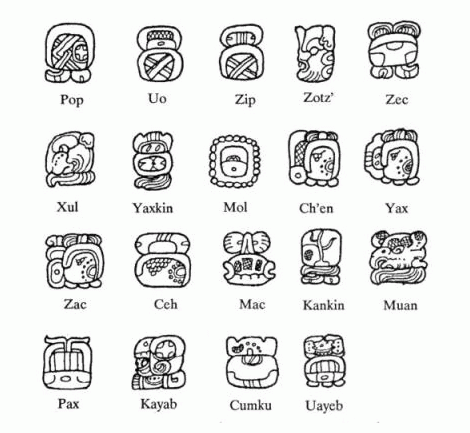
Haab refers to a 365 days calendar which is similar to our western calendar and is formed into 18 months of 20days each and there is the last short month which has only five days. Haab is a Maya word for “year”. It is the solar calendar of the Mayans. It was thought to be linked to agriculture so Haab was also called the “Mundane calendar” in colonial times and the month names are based on the seasons and agricultural events but researchers haven’t found any evidence that the Maya made any provision to reconcile the Haab with the season.
Month names and meanings:
Pop: mat, Wo: black conjunction, Sip: red conjunction, Sotz: bat, Sek: ?, Xul: dog, Yaxk’in: new sun, Mol: water, Ch’en: black storm, Yax: green storm, Sac: white storm, Keh: red storm, Mak: enclosed(may refer to the end of the rainy season), K’ank’in: yellow sun (may refer to ripe crops in the fall), Muwan: owl, Pax: planting time, K’ayab: turtle, Kumk’u: granary, Wayeb: 5 unlucky days. At the end of the calender there is last five days which nameless. 5 days were thought to be a dangerous time. Day numbers began with a “seating of” translated from “glyp” a named month. Glyphs represent periods of time. The first day of the year was Seating Pop. This was followed by 1 Pop, 2 Pop 3 pOP... 19 Pop, Seating Wo, 1 Wo and so on...
Mathematical equation shows that the cycle of the 260 day Tzolk’in and the 365 day Haab recombine on the exact same day they both started together after 52 turns of the Haab and 73 turns of the Tzolk’in or in 18980 days.
52*365(Haab) =73x260(Tzolk’in) =18980days.
These 18980 days equal 52years and is called the calendar round and a cycle of the Pleiades.
In 18980 days (52years) you become elder with the wisdom and responsibility to guide your people. When you are 52 years old the sun has travelled between its north and south extremes 52 times, the Tzolk’in has turned 73 times, the moon has grown full some 643 times and the Pleiades has returned to the same position it held when you were born.
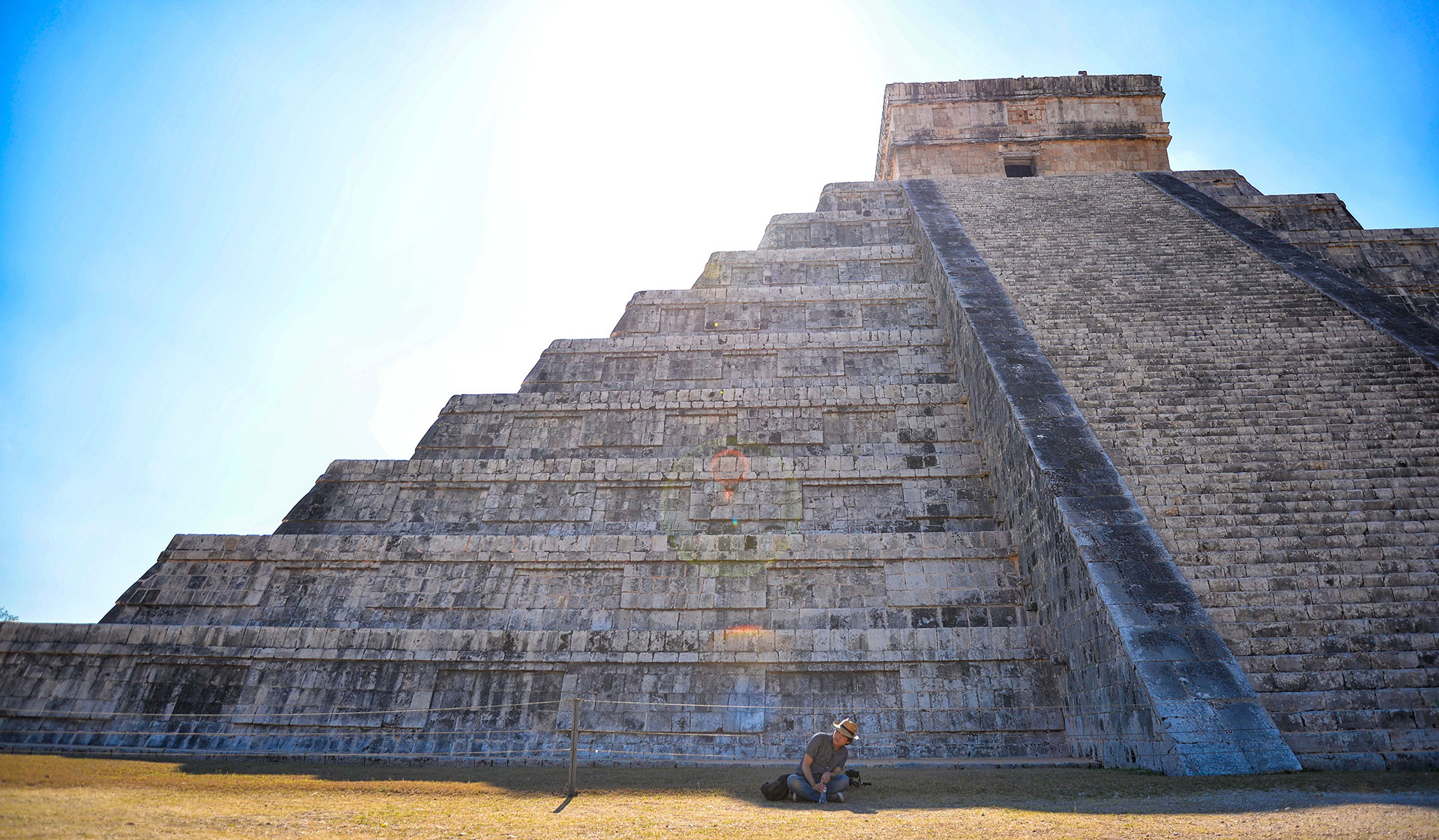
The pyramid in Chichen Itza was used as a calendar 4stairways, each with 91 steps and a platform at the top, making a total of 365, exactly equivalent to the number of days in a Haab calendar year.
Only the Haab calendar has a direct relationship to the length of the year. It was the civil calendar of the Mayas.
Mayan Numeral system was created based on simple daily life issues. In contrast to the decimal system that we use today, Mayan numerals are based on a vigesimal numeral system which means that the system was taking number twenty as base rather than ten.
Mayan Numeral system was created based on simple daily life issues. There are three main symbols for making up the numbers: zero which is shown with a shell shape, one which is symbolized with a dot, and five which is a simple horizontal bar. It is believed that the symbols were created by having the inspiration of fresh beans as the fresh beans have maximum 5 beans inside the skin. The skin would be resembled to the bar and each bean as dots.
As an example, if you would want to write 13, you would make two horizontal bars up to each other with a three horizontal dots above the bars.
NUMBERS AFTER 19
As the numeral system is based on twenty and its powers, numbers after 19 are written vertically from 1s, going up to 20s, 400s, 8000s, 160.000s …
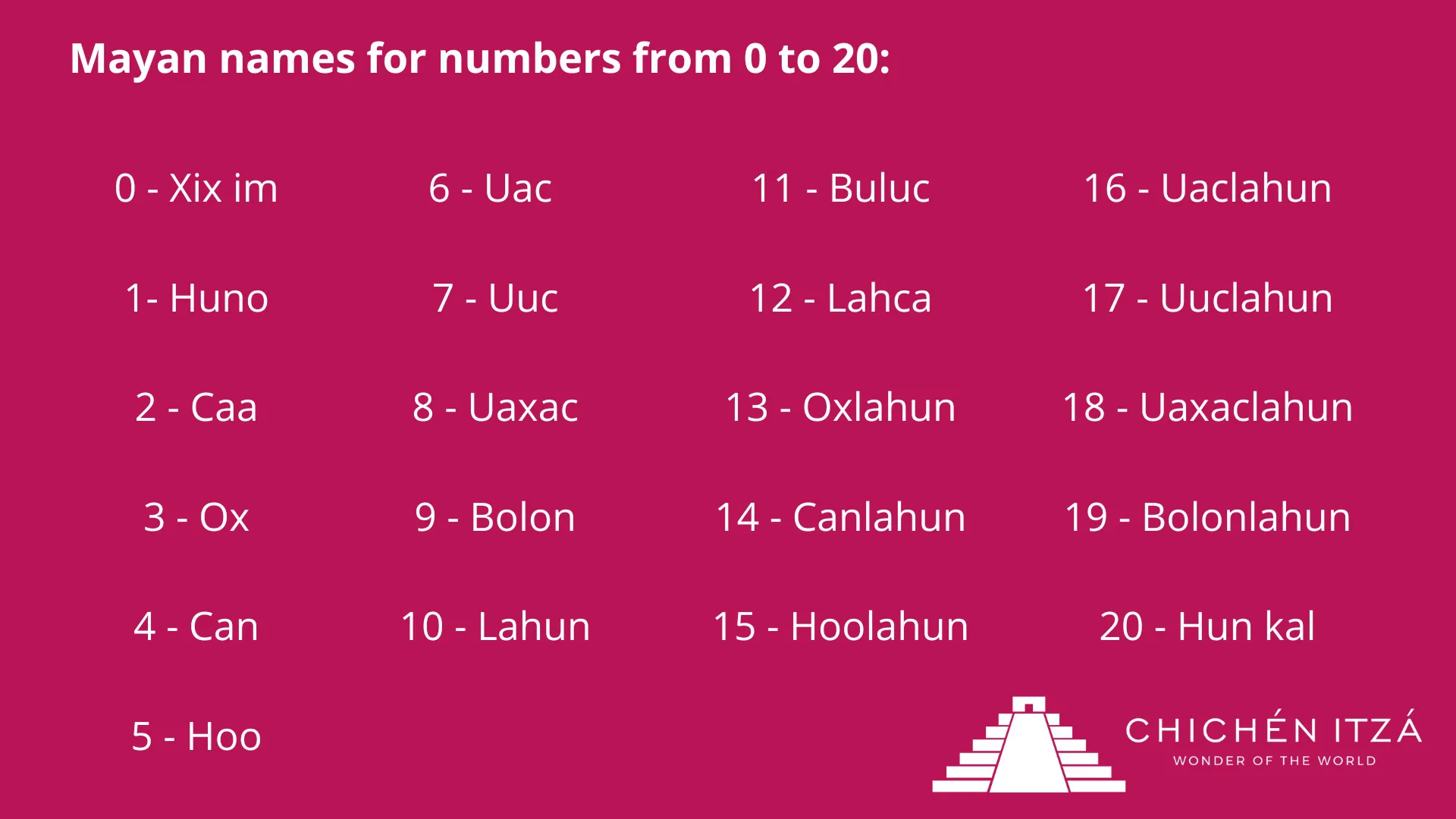
Mayan names of numbers from 0 to 20:
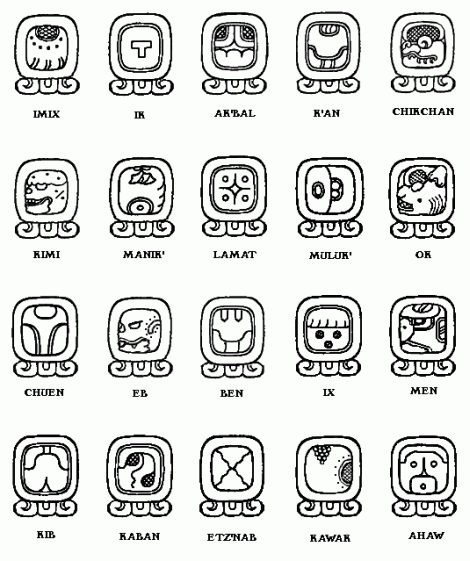
Tzolk’in is the divine one and the oldest one among the Mayan calendars. It is not typically what you'd think of when you think "calendar". You couldn't hang it on the wall, or carry it around as a day planner. It is amazing that Mayas never used the wheel to move stone but they did use the great wheel of time to order every detail of their lives. Tzolk’in is the hub of Maya time. It looks like a round-within-a-round... a wheel-within-a-wheel.
Continuously renewing, it has cycled through seasons and thousands of years, through Maya Kings and Spanish conquerors, democracy and dictators, two World Wars, man’s walk on the moon and right now the dawn of the 21st Century.
Literally, Tzolk’in means recitation of days. Tzolk’in calendar is a ritual calendar having 260 days. It is formed into 13 months of 20days each.
At first, experts could not match the 260 day cycle to any astronomical thing. Many theories were put forward:
It could be the result of multiplying 20 (days) and 13 (months). The 260 days period can be critical, with 20 and 13 chosen. These numbers are the smallest common denominators. And also 20 and 13 are two important numbers for Mayas. There are different theories as with all things Maya.
Another idea was that 20 is a human based number for example the number of our fingers and toes. Literally 20 is “a person full of days”. In Maya Language “Unial” means 20days and it comes from the same root as “Uinic”, the word for man. “Hun Uinic” means 20. Additionally, the 13 of the Tzolk’in is for the 13 major gestures that you can make with your legs and arms, or articulations. When we put together this numbers, 13:20 is the time of the Tzolk’in links each of us human beings to the cycles of the planets of our solar system. It describes the energies of creation moving through cycles within cycles, based on a 13:20 ratio.
Also, each of the 20days has a corresponding direction and in this way 260 unites time with space. The number of 260 has several significant cycles. About 266 days before birth, a human baby is in the womb. About 263 days Venus is the morning star. During the summer growing season the Sun at noon is north of overhead for 260 days at 15 degrees latitude. 13 consecutive Jupiter-Saturn cycles of 20 years is 260 years. But with all these correlations, the 260 day cycle of the Tzolk’in has yet to be proven to relate to any natural phenomenon. Each day in the Tzolkin Round is unique, and has a new also unique energetic characteristic.
After some time, experts realized that it had something to do with the sun and the earth’s changeable magnetic fields at the equator and the poles. However, certainty came only after mankind’s progress in astronautics, space researches and space travels. It is hard to think of how the Mayans were aware of those magnetic fields thousands years ago.
For Mayas the “kin” is the basic unit of time and in Maya language a “kin” means a sun since kin is the name of the sun. Hours based on the Sun’s movement are not equal so the basic unit isn’t an hour. The sun’s face gives rise to the 4 directions east, west, north, south. In all Maya Languages the road of the sun defines space and time. In Maya language Lakin is east and means “the sun is born”, Cikin is west and means “the sun is eaten”, Xaman is north and means “right hand of the sun”, Nohol is south and means “sun’s left or hidden hand”. According to Maya east is at the top of a map of this four square plane of Earth.
If linguistic data is correct, The Tolzk’in was already in use before 1000BCE by the Maya and other Mesoamerican people. Later on, this calendar was projected backward to the beginning of this, the fourth creation in 3114BCE. Today, Modern Maya still keep its days. In the Guatemalan highlands the Tzolk’in is still in use by several Maya communities.
The Tzolk’in calendar has 20 different named days that are counted in cycles of 1 through 13 till all possible pairings of days and numbers have been made which takes 260 days. After 260 days the cycle starts new with all combinations have been made and day one and number one meet again.
1: ahau,
1: imix( the first day of the Tzolk’in),
2: ik,
3: akbal,
4: kan,
5: chicchan,
6: cimi,
7: manic,
8: lamat,
9: muluk,
10: ok,
11: chuen,
12: eb,
13: ben,
1: ix 2: menand so on until after 260 days the cycle returns to 1 ahau. 13 Ahau is the 260th day of the Tzolkin. Each of the 20days is a unique quality for Mayas and also each of the 13 bumbers represents a different principle. As a result each day in Tzolk’in calendar has characteristic or a special flavour that colours the day. Under the influence of the day’s quality a child born, a marriage undertaken, an activity begun.
Tzolk’in is a clock of universal time and was extensively used in Mayan inscriptions and codes for example symbols from the Tzolkin are carved into the stonework of the ancient Mayan pyramids. Mayan Time Science isn't astrological, isn't based on the stars, the planets or anything physical either. It can be confusing because it’s unfamiliar territory for the modern mind. It is an entirely new and also unfamiliar world based on nothing familiar to our common understanding of the World. The Tzolkin calendar expresses fluid, spiraling cycles of alternating life energy moving through space and time that continuously flow and encompasses the ever changing evolutionary process of living beings. As you become more familiar with the Tzolk’in round, it will get clearer.
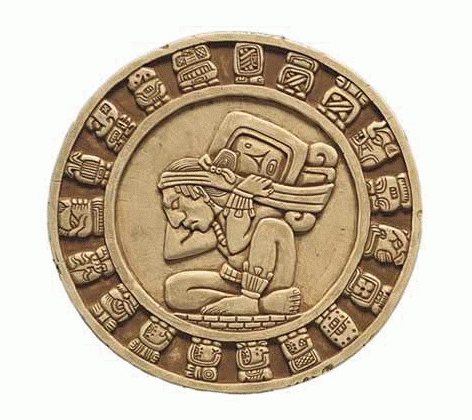
For Mayas time is not separate from human life, it is life, breath, death and transformation.
It enrolls the wheel of time which amounts to an historic era of 5.126 years; beginning 3.114 BCE, end 2012 AD. It is representing the number of days since the start of the Mayan era.
Long count inscriptions, according to units of varying lengths, record a day in time:
Kin is a day and the smallest unit
Unial is 20 times 1 day so it is 20 days
Tun is 20 times 18 days so it is 360 days
Katun is 20 times 360 days so it is 7.200 days
Baktun is 20 times 7200 days so it is 144.000 days
Shortly we can say that twenty of this k'ins is known as a uinal, eighteen winals make one tun, twenty tuns are known as a katun and twenty katuns make a baktun. The Long Count calendar identifies a date by counting the number of days.
For Example date according to Long Count:
“9.15.5.8.7” it is read as: “9 baktun, 15 katun, 5 tun, 8 unial, 7 kin” / or it is read as: “1.405.967 kin”.
The first date in the Long Count should be 0.0.0.0.0 and the baktun are numbered from 1 to 13. For the highest 13 to flip over would take almost 142 nonillion years. Scientists estimate the Big Bang took place about 15 billion years ago. The scale of Mayas vision of time is staggering by comparison.
The Long Count will again reach 13.0.0.0.0 on 21 or 23 December AD 2012 assuming one of the first two equivalences.
The year of 2012 (13.0.0.0.0) may have been the Mayas’ idea of the date of the re-creation of the world.

 ESPAÑOL
 FRANCES
 PORTUGUES
 ITALIANO